 Pace


When to pit in F1 25: box now, or one more lap?
You stop a lap late and rejoin behind a car you can't pass. You stay out and the car behind undercuts you. You run the hard to the flag and find out you still owed a compound. Pacedex recalculates your pit stop every lap — tyre life, where you'll rejoin, who can undercut you — and tells you what to do this lap, and why.
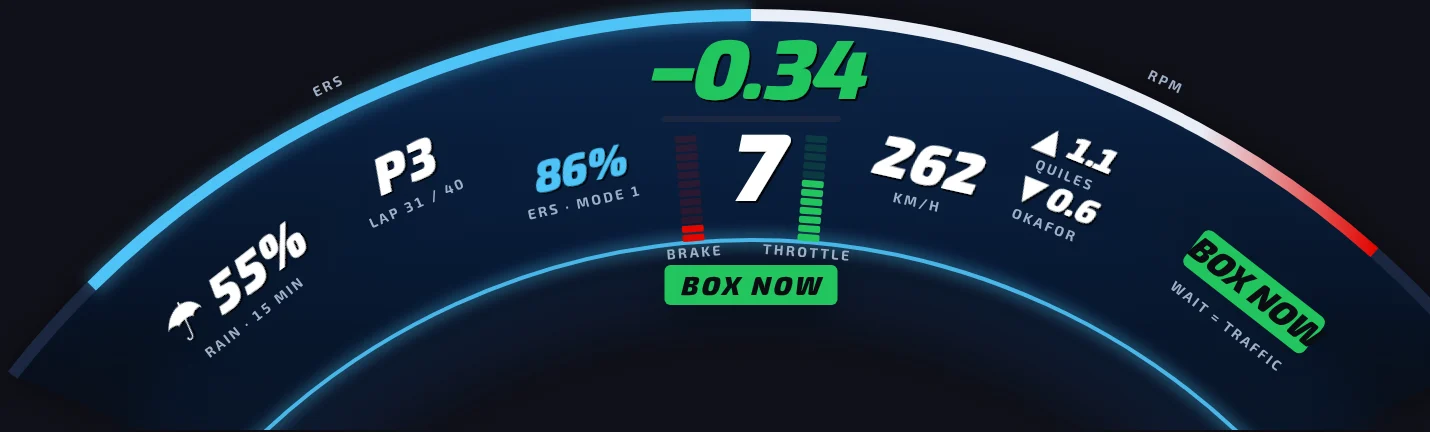
The in-game strategy only knows the plan you picked
The game shows the pit window of the strategy you chose in the menu. It doesn't look at who is where you'll rejoin, it doesn't watch the car behind sitting in its own pit window, and once you go off that plan, the window is gone. Meanwhile your tyre is wearing at your rate, not the game's.
That's the gap Pacedex fills: one decision, made from your live telemetry and everyone else's gaps, updated at the end of every racing lap.
A pit lap that comes with a reason
Every lap the app works out the best lap to stop, weighing tyre pace and track position together, and picks the next compound. The engineer says the lap and why: because it's the best overall race, because the tyre is wearing out, because your in-game strategy has a stop there, or because the compound rule still demands one.
It doesn't change its mind every lap: a new target has to be clearly better before it replaces the old one. And in the opening laps it waits for real pace data instead of guessing a stop from wear alone.
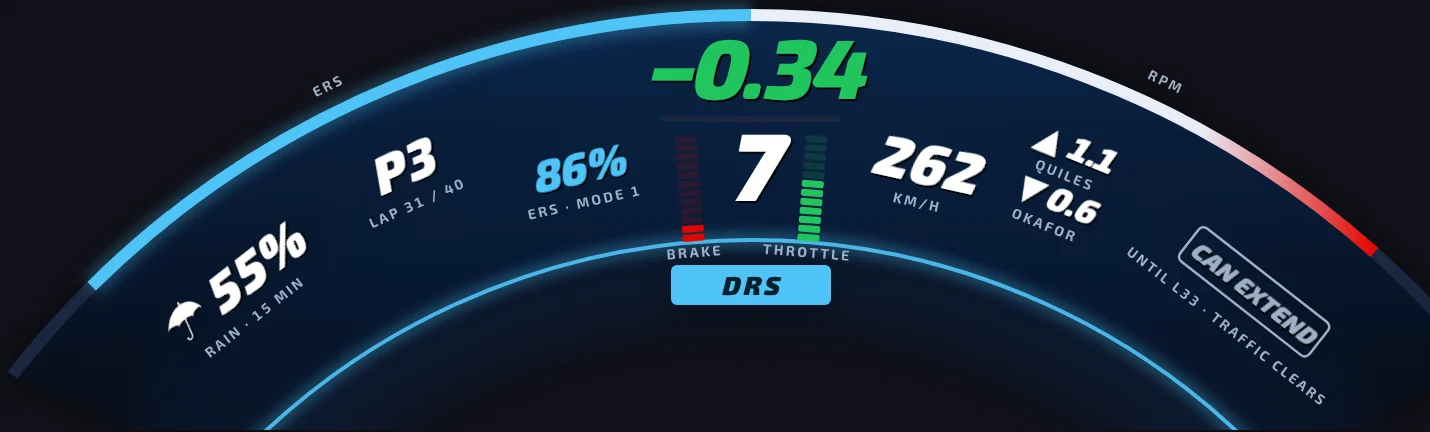
BOX NOW, BOX THIS LAP or CAN EXTEND
Near your window, the app compares stopping at the end of this lap with stopping on the next ones: what the tyre costs, plus what the traffic at your rejoin point costs. The result is one light, on the halo, the dashboard and the radio:
Waiting one lap costs 1.5 s or more — or the tyre won't do another lap. The reason comes with it: traffic, undercut, or tyre.
You're in the window: this lap is as good as any. No rush, no reason to wait.
Stopping now drops you into traffic; a lap or two later you come out better. It tells you until which lap.
Tyre, traffic and the undercut — in one sum
It projects your exit stopping this lap and next — with every gap drifting at each car's recent pace, not frozen. Stuck behind a car on the same pace? It counts the laps in dirty air. A car faster than your fresh tyres doesn't hold you up: it drives away.
A rival close behind, on the same number of stops, on old and worn tyres, is a threat: if he stops first he can come out ahead. In your window, that alone makes the call BOX NOW.
Two lines, never mixed up: around 70% wear the pace falls away — that's the ceiling for every plan. 80% is the puncture-risk alarm. Laps to that 70% come from your measured wear rate.
The time a stop costs isn't a table value: it's measured from your own stops at each track, so the undercut maths uses your pit lane, not an average one.
When a rival does stop, you hear it in context: cover him if your stop is close, or push on his cold-tyre laps if it isn't. And before the engineer calls an undercut of your own, he checks where you'd rejoin — into traffic, it becomes “stay out”.
A tyre model from your races, at your race distance
Tyre life comes from your own races at that track. And it matters which races: the game doesn't scale tyre wear in proportion to race length, so the app learns from races of the same distance (5%, 25%, 50%, 100%) and converts the rest. In our test on a real driver's history, the median tyre-life error in full-distance races dropped from 27 laps to 5.
New track, few races? It starts from the anonymous Pacedex community — only races at the same distance and with the same car rules (2025 or 2026 regulations) — and calibrates with your laps as you go. When the data is thin, it says so and keeps a margin.
It never tells you to finish on the tyre you started on
In a dry race you must use two different dry compounds. Until you have, nothing in Pacedex — not the radio, not the halo, not the box call — will say “go to the flag”, however long the tyre would last. The halo shows the stop as MANDATORY STOP.
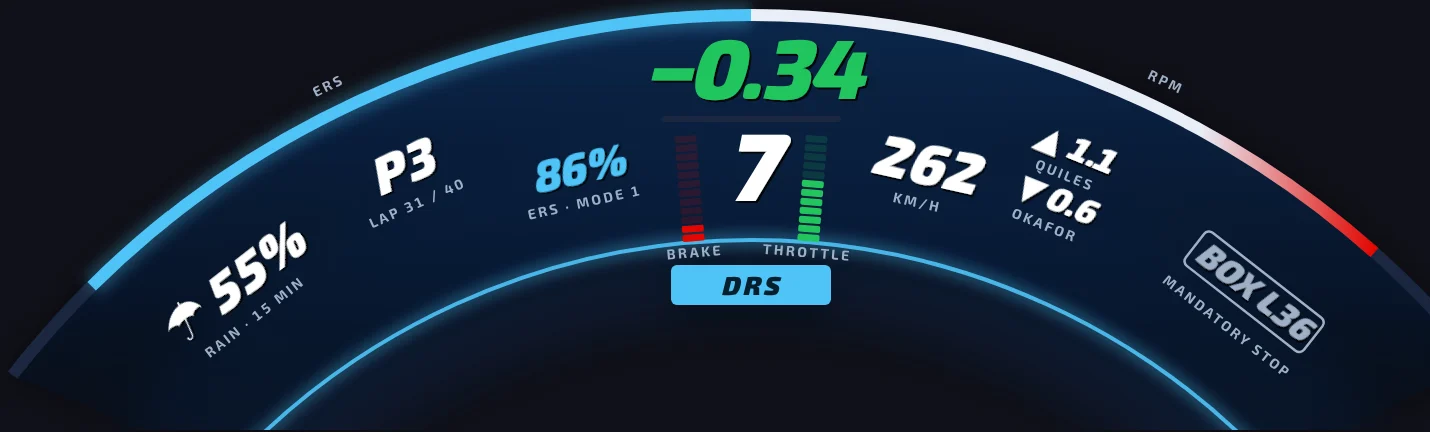
- Rain changes it: once inters or wets go on, the obligation is gone, and the strategy plans with wet tyres too.
- Short races with no stop to make are left out.
- Custom online lobbies may not require it: there it's a heads-up (“if the lobby requires two compounds, you still need the change”). You can set the rule to automatic, always or never.
Safety car and rain
A stop under the safety car costs about half of a normal one: if you're changing, the call is that lap. Under a virtual safety car the stop costs the same, so if you're already in the window, decide now. Duel and undercut talk waits for the green.
“Rain coming” is read from the forecast's weather, not from the chance percentage alone. If it's due near your window: box straight onto the right tyre and make it one stop; if it's due before, bring the stop forward.
On your radio, over the game, on the dashboard
- Radio: the engineer speaks the target, the box call and the reason — offline, in English, Portuguese, Spanish or Italian.
- Halo over the game (Windows): a window that replaces the game's HUD, with the box cell and the margin you have left on the tyre.
- Dashboard: the same light, with its reason, in the live HUD of the Pacedex dashboard.
- Ask: hold push-to-talk and ask “what are we doing from here?” — you get the best plan from the tyre on the car now, plus the best alternative with a different number of stops.
- After the race: the Debrief replays the strategy with real numbers — what stopping on another lap would have given you.
Every screen reads the same decision, made once: the halo and the radio never disagree.
What it can't know. The game never says whether the two-compound rule has been met: Pacedex deduces it from the compounds it saw you fit. If you open the app mid-race after a stop, it won't accuse you of owing one — it can't see the stint it missed.
Nobody knows if a rival will stop: the undercut is flagged as a risk, not a prediction. And the tyre model is only as good as your history at that track — it gets sharper with every race, and tells you when it's still guessing.
Frequently asked
Does Pacedex replace the game's own pit strategy?
It works on top of it. The game publishes the pit window of the strategy you picked in the menu; Pacedex reads it and tells you when it disagrees and why — tyre, track position or the compound rule. If you set your own plan in the app, that plan is the target.
How does it know how long my tyres last?
From your own races at that track, at the same race distance — the game doesn't scale tyre wear in proportion to race length, so a 50% race teaches little about a 100% one. With few races of your own it starts from the anonymous Pacedex community figure for the same distance and car rules, and says when the data is thin.
Will it tell me to finish on the tyre I started on?
Not in a dry race where the change of compound is still owed. The game doesn't say whether the two-compound rule has been met, so Pacedex tracks the dry compounds you've fitted; until there are two, no screen and no radio call says “go to the flag”. In custom online lobbies it's a heads-up, and you can set the rule to automatic, always or never.
What happens under a safety car?
The box-now / extend lights go quiet and the engineer handles it: under a safety car a stop costs about half of a normal one, so if you're changing tyres he calls it that lap. Under a virtual safety car the stop costs the same, and he tells you to decide now if you're already in your window.
Do I need an AI key or an account?
No. The strategy is race logic running on your PC — free, offline, no account. A key is only for the optional push-to-talk questions, and even those have a free daily allowance.
Which games and platforms?
F1 24, F1 25 and the F1 25: 2026 Season Pack. On PC it runs alongside the game, with the halo as a window over it; on PlayStation or Xbox the Android app receives the telemetry over Wi-Fi and runs the same engineer.
Know when to box — every lap
Free · no account. Pit calls, tyre model, voice engineer and the halo over the game, for F1 24, F1 25 and the 2026 Season Pack.

Radio lines above are real Pacedex calls, lightly edited; driver names are fictional.